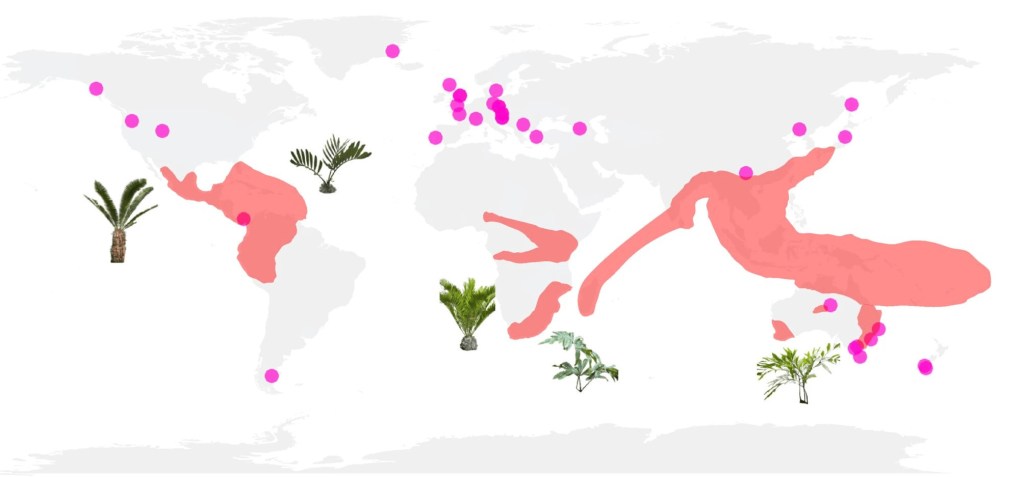
Recently, the results of a long-lasting project on the phylogeny and evolution of the cycads have been published on the journal New Phytologist. This project started with part of my Doctoral thesis at the University of Zurich, and continued and concluded while I was working at the University of Vienna thanks to funding from the Austrian Science Fund with co-pi Leyla Seyfullah. The work was greatly expanded thanks to a collaboration with colleagues from the University of Montpellier.
Although the article is Open Access, and a short Press Release from the University of Vienna has been picked up by a handful of popular science website, I am going to write a summary of the main message of our work here, to stress some points that I feel are important and might be missed by a cursory reading of the article or the press release.
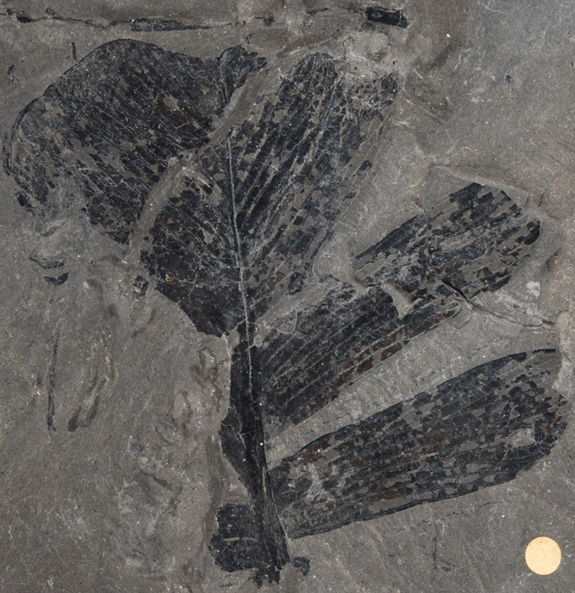
First, what is the article about? We aimed to uncover the evolutionary history of cycads by studying their well-preserved leaf fossils. We used a method called Total-Evidence dating under the Fossilized Birth-Death model. Unlike previous approaches that only used fossil information as rough guidelines, this method fully incorporated fossil data into the analysis. By combining fossil and existing species data, including molecular data, we were able to determine the relationships between different cycad taxa and estimate when they diverged from each other. To achieve this, we included 60 fossilized leaves and 321 living species, scoring their morphological characters, and also included molecular data for the extant species. Using the phylogenetic tree we inferred, we then reconstructed the biogeographical history of, considering the distribution of fossilized species as well as the configuration of the continents in the past.
Although the results of our biogeographical analysis are well described in the Press release, there are a few more points that I would like to stress.
Most cycad fossil leaves are not particularly related to the extant cycad groups
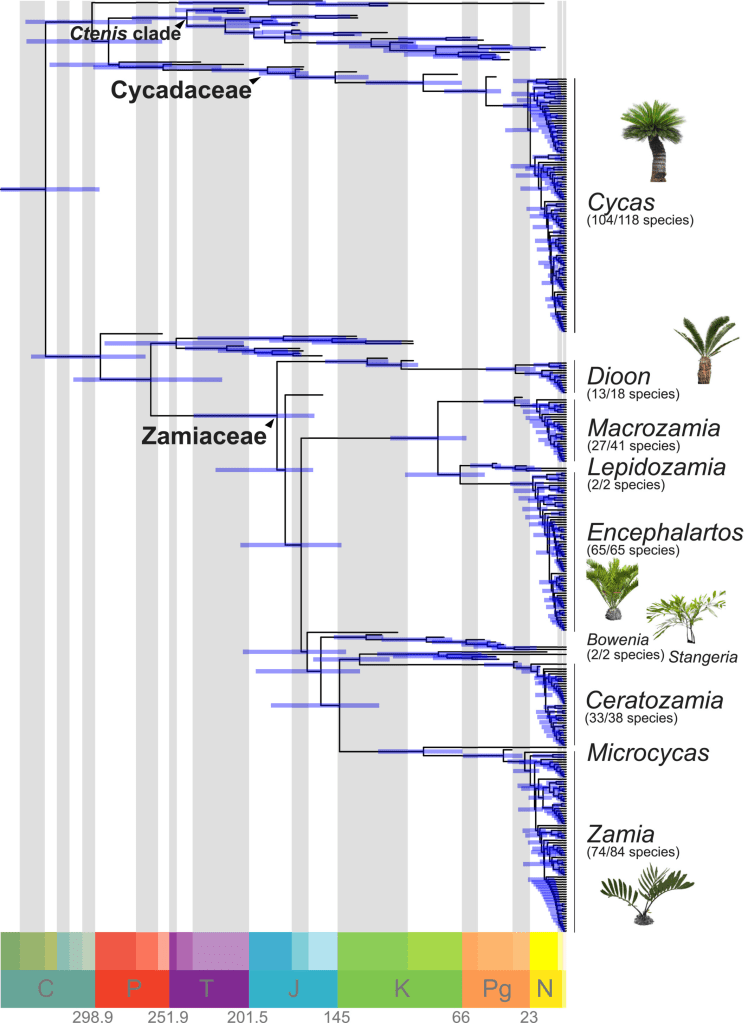
One of the most surprising result of our analysis was that our of 60 fossil leaves scored and analyses, only 8 are strongly supported as part of the ‘total-group’ Cycadaceae (i.e. they are placed on either the stem or crown of extant Cycadaceae with high confidence) and 18 as part of the total-group Zamiaceae.
Most cycad fossil leaves are either uncertainly placed on the stem of the extant families, such as many members of the wastebin taxon Pseudoctenis, or probably represent an extinct lineage of cycads that spanned from the Triassic to the Miocene, such as the members of the genus Ctenis and the genera Dioonopsis and Pterostoma. These were thought to be related to Zamiaceae, or even as close relatives of Dioon or Stangeria. Instead, the presence of a lost lineage of cycads opens to new avenues of research, to uncover the reason behind their expansion and demise.
Extant cycad families are mostly post-Mesozoic groups
Our analysis shows that both Zamiaceae and Cycadaceae are not remnants of ancient lineages going back to the Permian, but are relatively younger groups. The crown-group Zamiaceae originated some time in the Jurassic, and radiated in the Cretaceous. This radiation is also suggested by recent findings of rather unique (and miniaturized) cycad cones from the Cretaceous of North America. Crown group Cycadaceae, indicated by Cycas-like leaves, also originates in the Jurassic, though extant Cycas is much younger. This runs contrary to the idea of the extant cycads as remnants of a once prosperous groups: these are families as old as the flowering plants!
These results have some important implication for comparative analyses of extant and fossil cycads. The physiology and ecology of extant cycads is not a good proxy for their behaviour in the deep past, and similarly their morphology cannot be used tout-court for paleoartistic reconstruction. More attention needs to be paid when trying to reconstruct these actually extinct lineages. If you are interested about the possibilities for paleoartistic reconstruction, check out this post I wrote some time ago.
 Mario Coiro
Leave a comment